(E-E).E.v.g.e.n.i.j ..K.o.z.l.o.v Berlin |
|
home // E-E // biographie // art // eros // Leningrad 80s // Valentin Kozlov // 2 x 3m // events // lageplan // kontakt /
 / |
(E-E).E.v.g.e.n.i.j ..K.o.z.l.o.v Berlin |
|
home // E-E // biographie // art // eros // Leningrad 80s // Valentin Kozlov // 2 x 3m // events // lageplan // kontakt /
/ |
(E-E) Evgenij Kozlov
|
|
|
 |
|
Hannelore Fobo. Introductory Note On the limits of determining historical documents with the help of memory and logic. Anyone who deals with historical documents knows the problems that arise from describing their content, because any document, by its very nature, provides only a fragment of the relevant information – hypothetically, the essential fragment. At least this is what we must rely on. One might assume that sources of historical events experienced by contemporary witnesses are better to determine, especially if it is the witness who wrote the document in question. But this conclusion is not necessarily true, because writers, to some degree, outsource their memory to the document. Socrates explains this to his student Phaedros by telling him how the Egyptian god Thoth showed King Thamus the scripture he invented for humans as an “elixir of memory and wisdom”:
Plato, Phaedros, 274e-275b, translated by Harold N. Fowler, 1925 External link >> If the criticism of King Thamus is justified, it nevertheless overlooks an important innovation that goes along in parallel with Theuth’s elixir. Returning to one’s “outsourced memory” might not produce true wisdom, yet it fulfils a task which has its own significance, namely that of creating, through the speculative examination of a document from the past, a poetic version of it. This is shown by three conversations I had with (E-E) Evgenij Kozlov about his music recordings on the pages of a notepad from the 1980s, 58 entries altogether. We discussed them on two consecutive days, 23 and 24 April 2025, with a “postscript” some days later. As always, we talked in Russian, and the following days, I wrote down memory protocols in German, which I then translated into English. Since I made the transcripts not long after our conversations, I assume that my memory has not let me down, and I hope that the meaning of the statements has been preserved through the languages. Kozlov and I take different positions: while I attach great importance to determine, as unambiguously as possible, the circumstances leading to the recordings of the music, E-E contributes with details that may or may not have played a role. In our dialogue, we put forward hypotheses and test them, often without being able either to validate or exclude them. In the end, we are no wiser than before, and, trivially speaking, we could have spared ourselves our exploration of the past. In other words, to a jury looking for evidence, the conversation would have been worthless. On the other hand, our reminiscences and associations form their own corpus of ideas, which, to a certain extent, are detached from the actual document and “actually make up the charm of the whole thing,” as E-E argued. In this regard, it doesn’t even matter that our assumptions could not be verified – they still give a general account of the potential the past held at any given moment. In Aristotle’s words, “poetry tends to give general truths while history gives particular facts.” (Poetics 1451b).
Conversations 23 April 2025 H.: I have scanned an old notepad of yours, there are a total of 17 pages on which you wrote the names of music groups, mostly American music, jazz, funk, fusion, among them Chicago, Chick Corea, Carlos Santana, James Brown, Stevie Wonder several times, some with their albums. They were obviously recorded them on [reel-to-real audio] tapes [bobiny], because they are listed as A and B sides. I checked the albums, they are mainly from the seventies and go up to1981. Do you remember who recorded them for you? E-E: No, I don’t. But how do you know that these were tapes and not cassette tapes? H.: As far as I know, you didn't have a cassette recorder in the 80s, only later, when you had your studio at the Fontanka [1989-1991]. E-E: [Sergei] Bugaev, after he sold some of my paintings in Sweden [in 1988, more >>] and kept the money for himself, wanted to buy me off with a cheap portable cassette recorder. I was very upset and rejected that. But somehow I still got a cassette recorder. Is there a date for the recordings? H.: No, there is no date, but I suspect it was in the mid-1980s. There is an entry on page 10 written with a pencil – “at Yuri’s / Gustav”, and you probably got to know him around 1984. Could it be that Guryanov [Gustav] did the recordings for you? E-E: I can't imagine that he owned these records. None of us had any money, neither did he. After all, Western records were quite expensive on the black market. I once exchanged some of my graphics for a vinyl record with American students I met on the street, but only to resell it right away. H.: Guryanov later became an avid collector of records. E-E: Ok, maybe he had some before, but I didn't see any at his place. Later, when we both had our studios at the Fontanka more >>, he often copied his cassettes for me. Whenever I went to see him and heard a track I liked, I would ask him to make me a copy, and he always did that, because he appreciated me and especially my art. H.: But this means that if the notepad is from the mid 1980s, I can't assume that Gurianov had anything to do with it. E-E: But you can't rule it out either. By the way, I had an acquaintance who made copying records on tape a business, maybe he was the one who did the recordings. H.: Yes, but I can't make a list of everything that would have been possible when the assumptions are so vague.
Private apartment in Leningrad equipped for copying records to tapes. Kozlov took this picture in 1979/1980. Copying Western music was an illegal but profitable business. The gentleman in the right corner wishes not to be recognised. Photo: (E-E) Evgenij Kozlov, E-E-pho-MP13 more >>
E-E: When I look at the titles, there is also Louis Armstrong with “Hello Dolly”, then that speaks more for the time before the Fontanka. The same applies to the recordings from Radio Luxembourg. H.: I was thinking, maybe you used the old tapes that your father left behind. E-E: Perhaps. His reel-to-reel tape recorder was huge and unwieldy, but you could easily buy tapes in the store. In any case, I certainly didn’t listen to my father's music. I don't know what he heard, Pugachova… H.: … or Vysotsky E-E: …possibly. Many people enjoyed listening to Vysotsky, because he described our life in an entertaining way, but neither Soviet pop singers nor songwriters were my thing. H.: And the choice of music from the pages, did you make it yourself? Or maybe someone selected it for you? E-E: I don't think that anyone recorded 17 tapes with A and B sides for me all at once, it takes an insane amount of time. H: Sure. I know most groups and musicians, they were all quite popular at the time, although some I couldn’t identify, for instance D.R.M., just three letters, some kind of abbreviation. They appear several times. Have you got any clue what they mean? E-E.: Honestly, no, I haven’t, though they remind me of DAF, the German band Deutsch Amerikanische Freundschaft. I can only offer you a guess: the D and the R from другая [drugaya, other], and the M from музыка [muzyka, music] – other music, that is, different tracks I wouldn’t detail. In those years, we enjoyed labelling things with Latin letters. By the way, I think it's likely that the recordings were tape-to-tape copies. H.: This would make sense. You actually noted disturbing noises in some of the recordings. There is also a phone number on the reverse of the cover page, maybe we should call there sometime. Below it you wrote “29 ноябр.” [Novemb.], and then there is a strange kind of arrow pointing to “3 дня” [day/daytime]. E-E: Above, “25 минут” [25 minutes], that’s my handwriting, but these two lines don't look like I wrote them myself, someone else must have written it. Unfortunately, the date is without a year, but whether it has anything to do with the recordings is not at all clear.H.: Maybe it was a dentist appointment. In other words, we don't know anything precise about the recordings, neither when, where nor how they were made, not even whether you selected the music yourself or someone else did it for you. All we can say is that you liked this particularly music. E-E: Yes, but if you just say that you don’t know anything about the circumstances, then the interesting speculations we have dealt with remain unmentioned, and they actually make up the charm of the whole thing.
24 April 2025 E-E: I thought about the recordings again and remembered that I did own a cassette recorder in Peterhof, not a very big one, though. To make the sound become better, [my friend Viktor] Labutov connected it to the radio, which he used as an amplifier. So I could hear the music reasonably well.
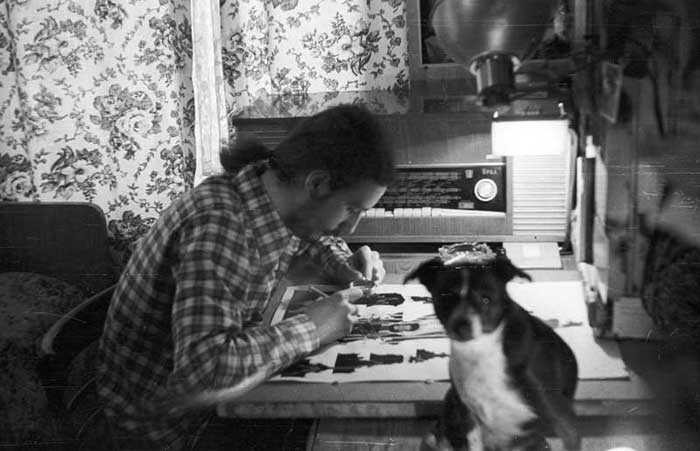
(E-E) Evgenij Kozlov in his studio and flat “Galaxy Gallery”, Peterhof (Petrodvorets), approx. 1978.
H.: I also noticed that there is a note written with a pencil on the second page of the notepad: Моя пленка у, “My tape with” and an arrow pointing to a name below it, Slava Starichek – Slava, the Old Man. E-E: Starichek, the Old Man, that was the nickname of Slava… H.: …Mogilevsky? E-E: Yes, Mogilevsky, the only resident of Peterhof who lived surrounded by his own alternative culture, that's why all those who had similar views met with him. There was no other place if you wanted to exchange ideas of this kind. And since there were a lot of Slavas, he had this nickname, the Old Man. Calling someone ”Old Man" was very topical at that time. H.: I remember, he lived with his girlfriend in a tiny one-room flat filled with self-made musical instruments. We still have a cassette with his experimental music somewhere. In any case, on this very page of the notepad, the tracks and artists are missing. Could it be that you gave Slava the tape so that he would record something for you chosen by himself? E-E: This sounds logical. However, the fact that I wrote a note “my tape at Slava’s” simply means that I would have forgotten it without the note. And for some reason I crossed it out, and the titles are missing Maybe he returned the empty cassette to me. Without such a note, what you give to someone else you often don't remember, and likewise, without crossing it out, you forget that it was returned to you. H.: Maybe it was Slava who recorded all the tracks on the notepad for you? E-E: Now we have completely deviated from our original assumption that it was Guryanov. But I really don't know whether Slava enjoyed this kind music, funk and fusion. I can’t exclude it either. H.: Well, then we'll leave it at that. What a pity!
30 April 2025 E-E.: Yesterday, as I was walking by your desk, my eyes turned to the notepad, and I had this strange intuition to open it. And you know what? I opened it on page 8 and sovled the riddle. What do you see? H.: Well, you noted Grace Jones. E-E.: Yes. But below? H.: On Side A, The Temptations and Disco Rock Machine, both crossed out. E-E.: And on Side B – D.R.M., which is short for Disco Rock Machine. I was too lazy to repeat the whole name. H.: And then, on Page 13, you kept this abbreviation. It’s really as simple as that!
Hannelore Fobo, 1 May 2025 |
| Uploaded 1 May 2025 |
|
home // E-E // biographie // art // eros // Leningrad 80s // Valentin Kozlov // 2 x 3m // events // lageplan // kontakt /
|