see also
KIASMA, Helsinki «THE RAW, THE COOKED, THE PACKAGED. The Archives of Perestroika Art» >>>>>> 
 |
|
As we look at Evgenij Kozlov’s photographs of the 80s and examine the motifs and events of those years, we notice that all activities took place in that universal world in which he lived: Leningrad and Petrodvorets, where his parents’ flat was situated, and that the people on the photographs were his friends and close acquaintances. In other words, unlike Rodchenko or André Cartier-Bresson, he did not photograph strangers. Photography came to him as naturally as painting, and it is in a sense true that the camera had the same function for him as the sketchbook for the artists of the previous centuries: it helped him to preserve for future interpretation the moment that reveals the person’s inner being, which, in his opinion, is the very essence of art. He did not simply fix specific gestures, glances and postures that interested him, but also provoked them by his presence with the camera. And in those rare moments when he wished to appear in the picture himself, he used the self-timer or gave the camera to someone else.
|
| Evgenij Kozlov: Georgy Gurianov, Timur Novikov, Igor Verichev, Valerij Alakhov 1985
«Иконография» Новые Художники в фотографии и документах. /
Iconography. The “New Artists” in photographs and documents.
Gallery Formula, Loft Project Etagi, 26.02.10 - 27.03.10, curators: I. Kuksenayte, A. Khlobystin
Photographs, documents, lightboxes, objects, documentaries and videos from private collections.
NTV program, still image from the newscast “Сегодня” / “Today” of March 4, 2010
|
|
Later he would select from the films single photographs or parts of them that presented a particular harmony of composition, novelty of gesture and expression of faces and figures. Afterwards these photographs would become his “models” for photo-collages and albums, graphics and paintings, where, as a rule, they appeared in a modified form. Since he developed films (monochrome negatives produced by Tasma and Svema) and printed photographs himself, he mastered the entire artistic process, from taking pictures to the final result: the work of art.
It is no mere coincidence that his friends were artists like himself, and many of them are well-known today as prominent personalities of modern Russian art and music. Evgenij Kozlov’s photographs present the “Who is Who” of the Leningrad art scene of the 80s: Valery Alakhov, Natalia Batisheva, Elena Bogdanova, Sergei Bugaev, Vladimir Chekasin, Denis Egelsky, Andrey Fitenko, Oleg Garkusha, Boris Grebenshikov, Georgy Gurianov, Vladislav Gutsevich, Yury Kasparian, Kirill Khazanovich, Konstantin Kinchev, Oleg Kotelnikov, Yury Krasov, Andrey Krisanov, Sergey Kuryokhin, Sergey Letov, Vladislav Mamychev, Andrey Medvedev, Ivan Movsesyan, Timur Novikov, Vadim Ovchinnikov, Andrey Panov, Natalya Pivovarova, Inal Savchenkov, Katya Selitskaya, Viktor Sologub, Grigory Sologub, Andrey Solovev, Ivan Sotnikov, Alik Tager, Aleksandr Titov, Viktor Tsoy, Nataliya Turik, Igor Verichev, Evgeny Yufit, Evgenij Kozlov, (Paquita Escofet, Agnes Horváth, Joanna Stingray).
|
|

|
Iconography. The “New Artists” in photographs and documents. Gallery Formula, Loft Project Etagi, Feb 26 - March 27, 2010
exhibition poster
photographs at the top on the left (at the top on the right?) and in the center by Evgenij Kozlov
|
|
The fact that Evgenij Kozlov’s photographs today have not only artistic value, but also serve as a rich documentary material about celebrities and unique events, concerts and exhibitions, illustrates, in a way, a side effect of the artistic approach. Indeed, the author had no such intention, except for the photographs of his own pictures at exhibitions and in his Galaxy Gallery flat in Petrodvorets, where he used to paint, as well as later at his Russkoee Polee studio (the Russian Field) at Fontanka 145.
An artistic photo is the result of an artist and his model’s combined creative act. Such a view on photography contradicts, to a certain extent, its interpretation in a historical context. The creative act is unpredictable and although it is born in a given moment in time, it is beyond the logics of cause and effect, beyond time.
Evgenij Kozlov’s understanding of the artistic product as an interpretation of the timeless life substance becomes obvious when we follow the transformation of a single subject from photography to graphics and painting. In the latter two, he combined realistic elements of photography with free forms of a drawing, thereby causing the photo-realistic images of faces and figures to lose their temporal nature.
|
|

|
Evgenij Kozlov, untitled (Anna Karenina 2), detail
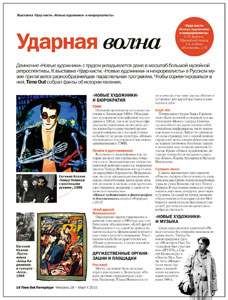
Time Out St. Petersburg N 4 (190) / 19 February 2010 “Ударная волна / Shockwave”.
“It is difficult to present the full scale of the 'New Artists' movement even with a large museum retrospective ...“
|
 |
|
This transformation enables the power and the potential of the human spiritual condition, that is, the intrinsic meaning of the picture, to emerge. The “classic novelty” of his expressive and modern artistic manner was highly appraised by all New Artists. According to Andrey Khlobystin, “Timur cherished them with all his heart.” Among all his various works, Evgenij Kozlov’s portraits of Georgy Gurianov, Timur Novikov, Igor Verichev, Oleg Kotelnikov and other artists of his circle received special acknowledgement. In an interview with Ekaterina Andreeva, published in her 2007 book entitled “Тимур. Врать только правду!” (“Timur. Lie the truth only!”), Georgy Gurianov stated that the works of Evgenij Kozlov produced a strong impression on him personally, and that he “preferred to all the others” his portraits by Evgenij Kozlov. . The striking spiritual impact of these works, which preserve the identity of the “model” without being realistic, has a potential to turn them into “new icons”. In view of its frequent reproduction in the press in connection with the 2010 exhibition “Udar kisti / Brushstroke” in the Russian Museum, the picture “Portrait of Timur Novikov with Arms Consiting of Bones” from 1988 can be considered one of the latest examples of such an iconic work.
|
Evgenij Kozlov «Portait of Timur Novikov with Arms Consisting of Bones»,1988, detail
ARTCHRONIKA art magazine, Moscow, 23 February 2010
click to enlarge image >> |
|
|
|
 |
 |
 |
100 TV: Итоги недели с Андреем Радиным / News of the week with Andrey Radin, February 28, 2010
“The question is: to no lesser extent then the oil crisis, the Petersburg artists' underground of the eighties made the collapse of the Soviet system possible. In view of today´s economic crisis is there any artistic force which can be said influential to the same degree? We will give you the answer right now.” |
Photographs and paintings by Evgenij Kozlov
(except picture at the bottom to the right).
Time Out St. Peterburg N 4 (190) / February 19, 2010 “Ударная волна / Shockwave”. |
Evgenij Kozlov: colored photograph, 1980s.
Festival logo “New Artists”
From left to right Oleg Kotelnikov, Inal Savchenkov, Georgy Gurianov, Timur Novikov, Sergei Bugaev, Igor Verichev, Valerij Alakhov.
painting on the photo: Georgy Gurianov. |
|
As a matter of fact, the transformation of photographic motifs began with film development, as the artist scratched hatches in the still wet emulsion of the selected negatives with a scalpel and a sharp pencil. These hatches or contours later appeared on the photographs as white and black lines, accentuating, supplementing or altering the images and figures. After selecting a particular printed photograph, Evgenij Kozlov painted it with special solutions, ink, Indian ink and felt pens. These alterations can be partly seen in the paintings. Photo materials, however, were used not only to supply motifs for graphics and painting, but also in photo-collages, along with other materials, such as newspaper and magazine clippings, colored ribbons and Letraset dry transferrable letters. This technique was used by the artist most extensively between the years 1984 and 1986, when he created the large triptych of 1984, which is now in the collection of the Russian Museum, the collages “Deutschland”, “Новогодняя ель” (“Christmas Tree”) of the same year, the 1985 “Kino” poster, the photo albums “SEXPOPS”, “Гуд Ивнин Густав” (“Good Evening Gustav”), “1984 – 1990”. For the 1987 work “Сто Вопросов и Ответов» (“A Hundred Questions and Answers”), he glued a number of photographs together in the form of a large picture of 171 cm x 354 cm for future painting. We know that the album “Гуд Ивнин Густав” (“Good Evening Gustav”) was particularly liked by Georgy “Gustav” Gurianov and Timur Novikov; the latter took it home after the exhibition during the performance “Anna Karenina” in 1984.
|
|
 |
top: collage by Oleg Kotelnikov
bottom: Evgenij Kozlov: triptych-collage, 1984
Exhbition “Удар кисти / Brushstroke” at the Russian Museum, St. Petersburg, February - May 2010
curated by E. Andreeva and V. Dobrovolski
photo A. Tager
click to enlarge image >>
|
|
|
|
|
|
 |
|
 |
|
 |
Evgenij Kozlov: Album «SЕХPOPS»
Exhibition “Удар кисти / Brushstroke”, at the Russian Museum, St. Petersburg, February - May 2010. Still image form video. |
|
Evgenij Kozlov: photo album «Гуд Ивнин Густав / Good Evening Gustav» 1984. detail.
Iconography. The “New Artists” in photographs and documents. Gallery Formula, Loft Project Etagi, Feb 26 - March 27, 2010
Still image from the documentary by Ivetta Pomerantseva.
More pictures of the series "New Stilyagy" and concert of "Strannye Igry" at DK Lenina 1985"
click here >>
|
|
Evgenij Kozlov: Triptych-Collage, 1984, detail of left part
Exhibtion “Удар кисти / Brushstroke” at the Russian Museum, St. Petersburg, February - May 2010
NTV program “Сегодня / Today”, March 4, 2010 |
 |
|
It is not surprising that Evgenij Kozlov “was chosen to be the permanent artist of the Kino band” (quoting once again Georgy Gurianov from the book by E. Andreeva). He photographed the band members in 1984 for the cover of the vinyl recording “Начальник Камчатки” (“Nachalnik Kamchatki”), which he designed as a painted photo-collage (this work appeared on the 1998 CD cover, showing Victor Tsoy holding it in his hands, and in 1984 the album was released with another photograph of E. Kozlov painted by Georgy Gurianov). In Timur Novikov's studio, Evgenij Kozlov made a photo series of a performance to present the album cover, and there as well he organized the photo shooting of the Fashion Show for the only issue of the New Artists' magazine, in which he was responsible for the fashion column.
|
Evgenij Kozlov:
LP album cover Kino «Начальник Камчатки / Nachalnik Kamchatki», 1984
from left to right Yury Kasparian, Aleksandr Titov, Viktor Tsoy, Georgy Gurianov
click to enlarge image >> |
|
At Sergey Kuriokhin’s request, he also made a series of photographs for the album cover of “Insect Culture”, the first LP of Pop-Mekhanika, released in 1987 in Liverpool along with the New Composers. The cover shows Sergey Kuriokhin and New Composers Valery Alakhov and Igor Verichev in an unusual perspective, walking at a rapid pace through the Passage shopping mall in St. Petersburg. The booklet of the cassette and the CD released by SoLyd Records in 1998 included other photographs of the street performance for the LP.
|
|

|
Evgenij Kozlov:
LP album cover «Insect Culture», the first record of Pop Mekahnika / Popular Mechanics,
released 1987 in Liverpool along with Новыe Композиторы / New Composers,
in the front of the picture: to the left Valery Alakhov, New Composers,
in the center Sergey Kuryokhin, Pop Mekhanika
to the right Igor Verichev, New Composers
click to enlarge image >>
|
 |
|
After 1990, Evgenij Kozlov turned to color photography and immediately began taking much less photographs. Presently, he has (almost) completely stopped taking pictures, as he has no such need for his art of the current period. Moreover, the photographs of people, where he discovered inspiration for his art, used to be of more importance when his relationship with the outer world was more significant to him; now, however, his relationship with the inner world prevails.
As far as I am concerned, his photographs of the 1980s are of great interest: I met Evgenij Kozlov in 1990, and they revealed to me this extremely significant period of Russian art. In 2000, I began to compile an archive of these photographs. It was no easy task, as the films were cut, and the pieces were not kept in the original order but were arranged as it suited the author’s artistic goals. Furthermore, the negatives were partly lost, from which only proof sheets and single photographs remained. Amid approximately 6000 negatives that now have their nomenclature, 2200 are directly related to the Leningrad / St. Petersburg art scene.
|
Evgenij Kozlov “Portrait of Viktor Tsoy”, 1984
more photographs from the series click here >> |
|
The total amount of the original print photographs (“vintage”) is hard to establish. As a rule, while printing a film, Evgenij Kozlov made additional copies, which he presented to the artists who can be seen on the photographs. As a result, a substantial part of these photographs is now in the private collections of Timur Novikov, Oleg Kotelnikov, Georgy Gurianov, Sergey Kuriokhin, Igor Verichev, Valery Alakhov and others. They are exhibited and printed in books and albums dedicated to this spiritual period in art, as Evgenij Kozlov himself regards it, and mostly in books about the New Artists. In recent years, they could be seen, among others, in the 2006 book “Корпорация счастья” (“The Corporation of Happiness”) by Andrey Khaas, the 2007 book “Тимур. Врать только правду!” (“Timur. Lie the Truth only!”) by Ekaterina Andreeva, the general catalogue of Timur Novikov’s work from 2003, the catalogue of the 2010 exhibition “Udar kisti / Brushstroke” in the Russian Museum, and in the Russian edition of the Rolling Stone magazine of May 2010. The author, unfortunately, is not always mentioned. The photographs are also widespread on the Internet.
|
|
 |
Evgenij Kozlov: Timur Novikov, Oleg Kotelnikov, photo from the series «Fashion Show» 1984
May 2010, Russian edition of the magazine “Rolling Stone”
more photographs from the series click here >>
|
 |
|
As for identifying people and events on the photographs, a great (according to Evgenij, an “amber”) body of information has been collected. In 2001, based upon the photographs, a number of articles was published in cooperation with Igor Khadikov, mostly articles related to exhibitions and artistic events of the New Artists, including the exhibition and concert “С новым годом” (“Happy New Year”) of 1985-1986 at the Rock club, the New Theatre’s performances “Anna Karenina” and “The Ballet of the Three Inseparable Ones”, the 1985 concert of Sergey Kuriokhin’s Pop-Mekhanika and V. Chekassin’s jazz quartet for the filming of the documentary “Диалоги” (“Dialogues”) directed by Nikolai Obukhovich, the 1984 fashion show at the Assa Gallery, the 1988 exhibition of the New Artists in the Sverdlov Culture House, the “Stiliagi” party and the concert of the Strannye Igry.
|
Collage to the left: Oleg Kotelnikov
Collage to the right: Evgenij Kozlov “Новогодняя Ель / Christmas Tree”
New Academy of Fine Arts, St. Petersburg / Feb 26 - May 17, 2010, curator - Andrey Khlobystin (to the right)
Still image from the documentary by Ivetta Pomerantseva.
|
|
|
|
|
|
|
|
 |
|
 |
|
 |
|
Collages by Evgenij Kozlov
Exhibition at gallery “ASSA”, 1984
From left to right “Deutschland”, “Новогодняя Ель / Christmas Tree”, untitled,
In the window “Self-portrait” 1983 and several small photo collages.
photograph: Evgenij Kozlov
more photographs click here >>
|
|
Evgenij Kozlov: photo collage «KINO»
Exhibition “THE RAW, THE COOKED, THE PACKAGED. The Archives of Perestroika Art”
Museum of Contemporary Art KIASMA / Finnish National Gallery
Helsinki, Finland, Nov 30, 2007 - Jan 6, 2008
photo: Ivor Stodolsky
click to enlarge picture >>
|
|
Evgenij Kozlov: black and white negative from the 80s
"THE RAW, THE COOKED, THE PACKAGED"
Museum of Contemporary Art KIASMA / Finnish National Gallery
Helsinki, Finland, Nov 30, 2007 - Jan 6, 2008
photo: Ivor Stodolsky
click to enlarge picture >>
|
|
In recent years, general interest in these photographs has been rapidly increasing, and we are frequently asked to provide photographs for many publications. Though I gladly look through Evgenij’s archive, the matter is not quite simple. As mentioned above, in photographing people Evgenij Kozlov did not wish to produce an archive or a documentary. An artist’s view is not the one of a historian, researcher or documentarian. In other words, what we have is no historic archive, which we might use to illustrate facts of history. Moreover, to present the artist as a photographer means to draw the viewer’s attention to a genre of art which, although necessary for the development of his artistic work as a whole, was in itself not of primary importance. This is why we included in this book not only photographs in their original form, but also examples of the painted photographic prints, as well as reproductions of portraits in painting and graphics. This way, we can better understand the significance of photographs in the artist’s work.
At the same time, an extraordinary gallery of the next Russian avant-garde artists appears before our eyes.
Hannelore Fobo, August 27, 2010
|
|
 |
“Тимур на коне / Timur on Hoseback” - Detail of Evgenij Kozlov's painting from 1988 on the cover of the catalogue of the exhibition
“De Nya fran Leningrad” (The New from Leningrad), Kulturhuset, Stockholm, August 27 - September 25, 1988
Graphic work: Slow Fox / Johan von Friedrichs, offset print,, 31 х 24 cm,
size of the painting approximately 2 х 1 m, whereabouts unknown.
click to enlarge picture >>
|
|
|
|
|
|
|
|
 |
|
 |
|
 |
|
Evgenij Kozlov
Portrait of Oleg Kotelnikov with crocodile
and red dot
Oil, canvas, 70 х 70 cm, 1988 |
|
Evgenij Kozlov
Igor Verichev
Paper, ink, oil, 77,5 х 50 cm,1987 |
|
Evgenij Kozlov
Self-portrait with blue eyes
Paper, oil, 94 х 70 сm, 1989 |
Uploaded 2010
Last updated 20 August 2023
|

